Sympathetic nervous system 2
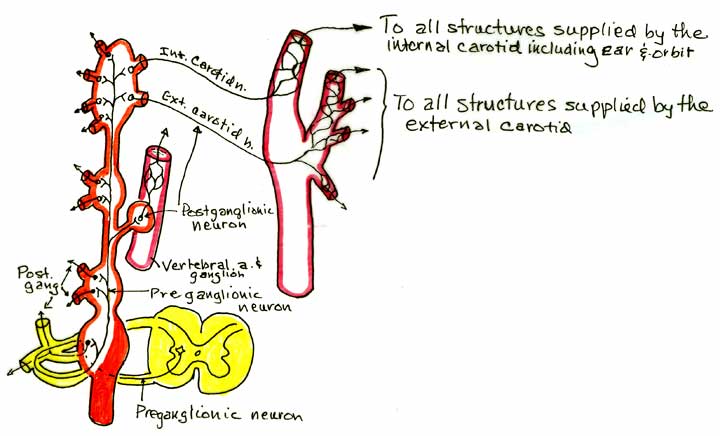
After the synapse, postganglionic fibers have 3 choices to leave the sympathetic chain:
- travel laterally in a gray ramus communicans to reach a cervical ventral primary ramus. The superior cervical ganglion sends gray rami to C1-C4 VPR; the middle sends rami to C5-6 typically, and inferior sends gray rami to C7-8 (and T1 if it's stellate).
- travel anteroinferiorly into the chest as cervical cardiac branches to participate in the cardiac plexus. These are very much like visceral nerves seen in the thorax, lumbar, and sacral regions, but it would have been too logical to call them cervical splanchnic nerves.
- travel as external or internal carotid nerves to reach either the external or internal carotid arteries and form perivascular plexuses on these arteries (similar to the perivascular plexuses in the abdomen, i.e. celiac plexus). These fibers then primarily distribute to target tissues along blood vessels (of course, blood vessels are themselves the primary targets). There is one exception (isn't there always?): some fibers leave the internal carotid plexus as the deep petrosal nerve. More on this in the story of the pterygopalatine ganglion.
|