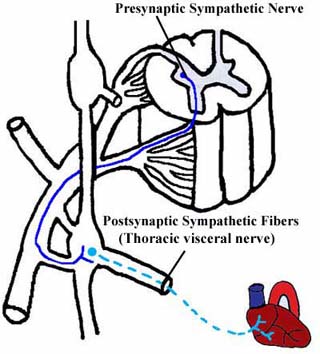
Within the thorax, the sympathetic nervous system innervates the heart, trachea, bronchi, lungs and esophagus. To reach these organs, the postsynaptic sympathetic fibers exit the sympathetic trunk as cervical cardiac branches and thoracic visceral nerves (the thoracic visceral nerves could not be called thoracic splanchnic nerves, because that name is used for another type of sympathetic visceral branch, which you will see soon). These nerves enter the cardiac, pulmonary, and esophageal plexuses to innervate their target organs. Sympathetic innervation to the heart increases heart rate and strength of contraction, as well as dilates the coronary vessels. Sympathetic innervation to the trachea and lungs leads to bronchodilation and reduced secretions, maximizing air exchange. Sympathetic innervation to the esophagus decreases peristalsis and limits the blood flow in order to preserve blood for the skeletal muscles.
|  |


