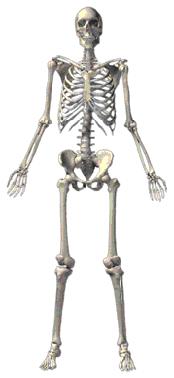
This module presents the nomenclature of movement at the joints of the lower limb. When you first approach your study of the lower limb, concentrate on the motions and less on the names of muscles producing those motions. After you have studied the lower limb, use this module to review and summarize muscle actions at the joints of the lower limb.
The lower limb is our primary tool for locomotion, and therefore it is adapted to provide a stable yet mobile structure. There is a great number of joints within the entire lower limb, allowing for locomotion over uneven ground at varying velocities and with rapidly changing directions.
In comparing the upper and lower limbs, it is evident that the upper limb is specialized as the organ of manipulation, and the lower limb serves for locomotion. To serve these purposes, the upper limb emphasizes mobility and sacrifices stability, while the lower limb emphasizes stability and sacrifices mobility. The contrast is perhaps most striking when comparing the mobile pectoral girdle (clavicles and scapulae) to the rigid pelvic girdle (os coxae and sacrum).